From boiling the kettle in the morning to sticking a load of washing on, we rely on electrical appliances throughout the day without giving much thought to how much energy they actually use.
Some appliances are far more power-hungry than others, while those that run constantly can quietly add up over time. Knowing where most of your electricity is going can make it easier to spot simple ways to cut your usage and potentially bring your energy bills down.
Here is a handy guide to some of the key appliances that are pumping up the cost of your electricity bill, plus some tips to help you reduce said costs.
Which appliances use the most electricity?
| Appliance | Typical power usage | How often it’s used | Electricity usage |
| Electric shower | Very high | Short periods | High |
| Tumble dryer | High | Regularly | High |
| Electric oven | High | Regularly | High |
| Dishwasher | Moderate-high | Regularly | Moderate-high |
| Washing machine | Moderate | Regularly | Moderate |
| Fridge-freezer | Low-moderate | Constantly | Moderate-high annually |
| Kettle | High | Very short periods | Moderate |
| TV | Low | Several hours | Low-moderate |
Why do some appliances use more electricity than others?
How much electricity an appliance uses comes down to three main things: how powerful it is, how long it runs for and how often you use it.
Appliances that generate heat, such as electric showers, ovens and tumble dryers, tend to need much more power while they’re running. But high wattage doesn’t always mean high overall electricity use. A kettle, for example, draws a lot of power but is usually only switched on for a few minutes at a time.
On the other hand, appliances such as fridges and freezers use less power at any one moment but operate around the clock. That means their electricity consumption can build up considerably over the course of a year.
Ultimately, it’s the combination of power and usage time that determines how much electricity an appliance really uses.
The household appliances that use the most electricity
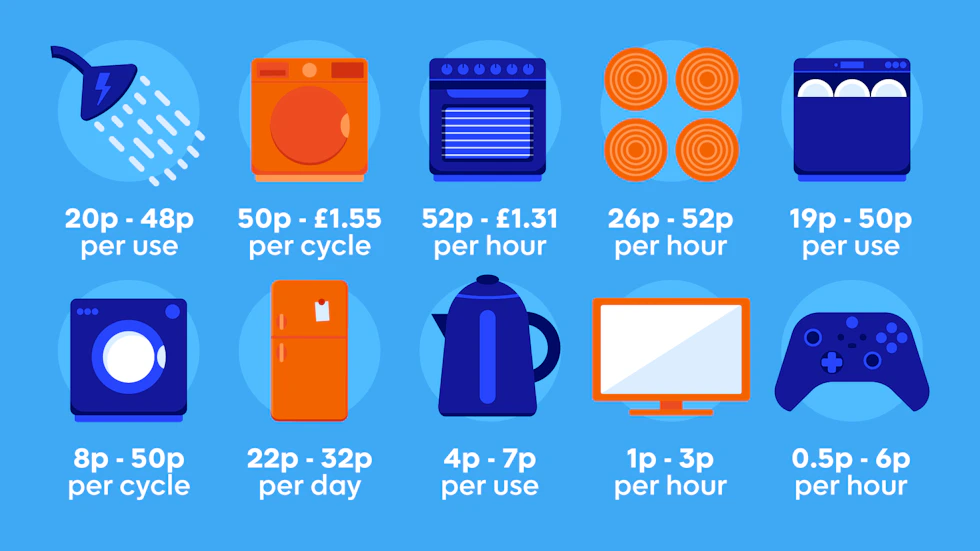
Let’s dive deeper into the appliances listed before to discover just how much energy usage they take up at a time, plus how much they cost per use.
Do note that the following figures are averages and not exact and are mostly, if not entirely, found on Which?. They can and do fluctuate and vary depending on a number of reasons, which will be explained for each appliance.
Electric showers
20p – 48p per use
Electric showers require instantaneous electricity to heat the water quickly so you aren’t left shivering in a cold shower for too long before it heats up.
Unsurprisingly, that comes at a cost of energy consumption, although the number varies depending on the power rating of your shower as well as how long your shower is.
Typically, an electric shower uses between 0.7 kWh and 1.75 kWh of energy per use, although it depends on the power rating of the shower, of which they are typically either 7.2-7.5 kW, 8.5 kW, 9.5kW, 10.5kW and 11.5kW.
The higher the power rating, the higher the thermal output and stronger the flow is at the cost of higher power usage.
- 7.2-7.5 kW = 1.25 kWh for a 10-minute shower
- 8.5 kW = 1.42 kWh for a 10-minute shower
- 9.5 kW = 1.58 kWh for a 10-minute shower
- 10.5 kW = 1.75 kWh for a 10-minute shower
Tumble dryers
50p – £1.55 per cycle
Dryers are a big cost in the colder periods of the year which then gets offset in the warmer seasons as drying can then be done outside.
It’s a killer nonetheless, though, especially with certain types of tumble dryers. There are three main types: Vented, condenser and heat pump.
Vented tumble dryer – Spins and heats up the clothes, then pumps the damp air out of a hose. The most costly type at £1.54 per cycle.*
Condenser tumble dryer – Lifts the moisture from the clothes and collects it in a container, ready to be emptied when full. Close to vented dryers cost but slightly lower at £1.51 per cycle.*
Heat pump tumble dryer – Collects moisture like condenser dryer, but recycles hot air that gets lost and uses it to keep drying the clothes. The most energy efficient dryer type at 63p per cycle*
As well as type, how much washing is put into the drum counts towards the energy usage. A more full load requires more energy to dry it all.
*Based on an average electricity cost of 29p per kWh.
Electric ovens & hobs
Oven = 52p – £1.31 per hour | Hob = 26p – 52p per hour
Electric ovens and hobs are among the more power-hungry appliances in the kitchen, largely because they need to generate and maintain high temperatures for extended periods. Which? estimates that a built-in single electric oven costs around £62 a year to run when used roughly three times a week.
Hobs can also add a noticeable amount to your electricity usage, particularly if several rings are running at once. Induction hobs are generally more efficient than traditional electric or ceramic models, as they transfer heat directly to the pan rather than heating the surrounding surface first.
How much you spend ultimately depends on how often you cook, how long the oven or hob stays on and the type of appliance you have.
Dishwashers
19p – 50p+ per use
The energy consuming part of a dishwasher comes from the heating of the water when in use. Modern eco programmes can considerably reduce this usage, but it is still the main culprit.
Dishwashers consume between 0.8 kWh and 1.8 kWh per cycle depending on the programme used. An eco programme is the most efficient, using about 0.54 – 1.2 kWh per cycle – a big saving compared to 1.2 – 1.8+ kWh used during standard or intensive programmes.
Different model types make differences, too. Slimline models generally consume slightly less power, averaging around 0.8 kWh per standard load.
Washing machines
8p – 50p per cycle
Washing machines aren’t among the biggest instantaneous electricity users in the home, but their regular use means the costs can quickly accumulate. The average washing machine costs around £64 a year to run, based on four washes per week, or 208 cycles across the year.
Capacity can make a noticeable difference too. Which? data shows that a typical 7kg washing machine costs around £52 a year to run, while a much larger 13kg model averages roughly £84 annually. These figures are based on washing an 80% full cotton load four times each week.
That puts washing machines somewhere in the middle of the pack for household electricity use – considerably below the likes of tumble dryers, but enough of a regular expense to make them one of the more significant kitchen and utility room appliances.
Fridges & freezers
22p – 32p per day
Fridges and freezers don’t draw huge amounts of electricity at once, but they’re among the few household appliances running 24 hours a day, 365 days a year. That constant use means their energy consumption can add up considerably over the course of a year.
A standard freestanding fridge-freezer uses roughly 300kWh per year, which works out at around £79 annually. Integrated fridge-freezers are slightly lower at approximately 295kWh and £77 per year.
These energy figures are approximate equivalents based on Which?’s current running-cost figures and an electricity price of 26.11p per kWh.
Standalone appliances also consume a significant amount over a full year. The average tall fridge costs around £54 annually, equivalent to roughly 205kWh, while an under-counter fridge averages about £48, or around 185kWh.
Freezers can be particularly demanding depending on their size. Which? estimates that an under-counter freezer uses around 132kWh per year, a tall freezer around 212kWh, and a chest freezer roughly 178kWh annually.
They’re a great example of why high wattage isn’t everything. A fridge or freezer may use relatively little electricity from moment to moment, but keeping food chilled or frozen every hour of every day makes them substantial annual energy users.
Kettles
4p – 7p per use
Kettles might only be switched on for a few minutes at a time, but they use a surprisingly large amount of power while they’re boiling. Unlike fridges and freezers, however, their short running time keeps their overall electricity consumption relatively low.
Which? estimates that the average kettle costs around £39 a year to run, based on boiling one litre of water twice a day and boiling up to the minimum fill line another three times each day. At the current average electricity rate of 26.11p per kWh, that’s equivalent to roughly 149kWh of electricity per year.
There can still be a fair bit of variation between models. Which?’s testing puts annual kettle running costs anywhere from around £24 to £55, while full-size models can commonly draw somewhere in the region of 2,000W to 3,000W when switched on.
So, while the kettle is one of the more powerful small appliances you’ll regularly use, its brief bursts of activity mean it’s considerably less costly over a full year than many larger household appliances.
TVs & games consoles
TV = 1p – 3p per hour | Games console = 0.5p – 6p per hour
Individual devices aren’t necessarily major electricity users, but several hours of daily use plus standby consumption means entertainment setups shouldn’t be ignored.
TVs are relatively modest compared with appliances that generate heat, with Which? estimating the average TV costs around £29 a year to run, or roughly 111kWh. Screen size matters too – larger 65-75-inch models can average around £35 a year, compared with roughly £23 for a 40-43-inch set.
Games consoles vary more significantly. A PS5 can cost around £41 a year if used for two hours every day, while an Xbox Series X is closer to £23 and a Nintendo Switch 2 considerably less at around £3.65.
Remember that gaming usually means powering both the console and TV at the same time, so longer sessions naturally increase the overall electricity used.
Does leaving appliances on standby use much electricity?
Leaving an appliance on standby still uses electricity, but for most modern devices the amount is fairly small. This is sometimes referred to as standby power or vampire power, as the appliance continues drawing a little energy even though you aren’t actively using it.
Modern efficiency standards have helped reduce this considerably. Current modelling for UK homes assumes many devices use no more than around 0.5W in standard standby mode, although devices displaying information or maintaining a network connection can use more.
One device sitting on standby therefore isn’t likely to make a dramatic difference to your electricity bill. The issue is that households can have TVs, consoles, monitors, speakers, kitchen appliances and other electronics all sitting idle at the same time.
Individually their consumption might be tiny, but together and across an entire year, unnecessary standby usage can start to add up.
It’s also worth remembering that some devices, such as broadband routers, are designed to remain powered and connected rather than being regularly switched off.
Do newer appliances use less electricity?
Generally, newer household appliances are designed to be more energy efficient than older models, meaning they can perform the same job while using less electricity.
Improvements to motors, insulation, heating systems and other components have helped reduce the amount of energy many modern washing machines, dishwashers, fridges and other appliances require.
One of the easiest ways to compare appliances is through their energy-efficiency label. Many products use the modern A to G scale, with A representing the most efficient and G the least efficient.
The labels can also show actual energy consumption in kWh, although the measurement used varies by appliance – for example, it may be shown per 100 cycles, per 1,000 hours or across a year.
However, newer doesn’t automatically mean more efficient. Two modern appliances of a similar size can still have noticeably different energy consumption, and even products carrying the same efficiency rating can vary.
Checking both the energy rating and stated kWh consumption gives you a much clearer idea of how much electricity an appliance is likely to use.
How can I reduce how much electricity my appliances use?
Let me send you off with some handy Genius Tips for each appliance that aim to help reduce the energy consumption per use.
- Electric shower – Use eco mode (or your equivalent) during the summer. It turns off one heating element when the incoming water is warmer
- Tumble dryer – The Goldilocks zone with the dryer is roughly halfway to three-quarters full. Overloading blocks air circulation while underloading wastes power
- Electric ovens & hobs – Use lids on your pots and pans to trap heat and cook food faster, in turn using 30% less energy
- Dishwashers – Only run when the machine is completely full so as to make the most of the cycle rather than running half loads
- Washing machines – Washing at 30°C cuts significant power demand, and most washing agents boast strongest capabilities at lower degrees
- Fridges & freezers – Keep the fridge to 4°C–5°C and the freezer at -18°C. Going colder than necessary wastes electricity
- Kettles – Only boil what you need. Heating excess water wastes electricity, so pour in only as much as you actually need.
- TVs & games consoles – Choose eco mode where possible. For TVs, that dims the screen backlight or uses a sensor to match the room lightning. With games consoles, this sometimes includes full power down when turned off.