The energy price cap. For something that affects millions of UK households, it’s often misunderstood – and it’s easy to see why.
You might be asking yourself what the price cap does. Does it affect you? If so, how? Who decides what the price cap is? And, crucially, if there’s such a thing as an energy price cap, why are your energy bills still so high?
Well, don’t worry. In this guide, we’ll break down how the energy price cap really works, in plain English, so you can better understand your energy bills and what you’re actually paying for.
What is the energy price cap?
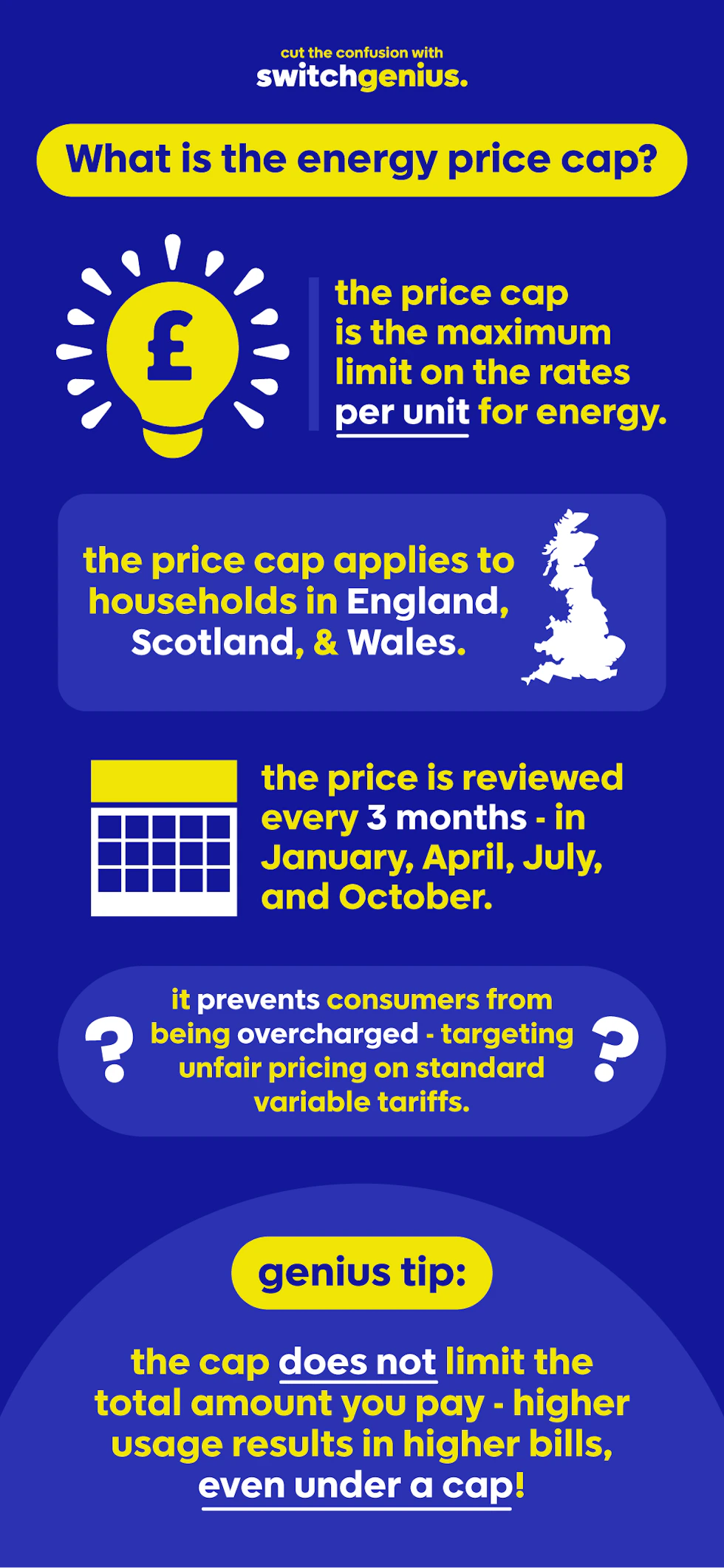
Put simply, the energy price cap is a limit set by Ofgem – the UK’s energy regulator – on how much suppliers can charge customers for gas and electricity. It primarily applies to those customers on standard variable tariffs (SVTs).
It’s important to note that it doesn’t cap your total energy bill. Instead, the price cap limits the maximum price suppliers can charge per unit of energy used, as well as the daily standing charge that covers the cost of supplying your home.
That means that if you use more energy, you’ll still pay more overall.
So what’s the point of it? Well, the cap is designed to protect households from excessively high pricing, especially those customers who aren’t on fixed tariffs. It’s also worth bearing in mind that suppliers can still charge less than the cap, which is why it’s always worth comparing deals to find the best price out there.
How does the energy price cap work?
The energy price cap limits the maximum amount that suppliers can charge for each unit of gas and electricity, as well as the daily standing charge added to your bill. So, rather than setting a maximum total bill, the cap sets a limit on energy prices themselves.
In a nutshell – your final bill still depends on how much energy you use, the price cap just limits how much that energy will cost.
The price cap is reviewed and updated by energy regulator Ofgem every three months (in January, April, July and October), based on factors like wholesale energy prices, network costs and supplier operating expenses. When energy markets become more expensive, the cap can rise; if costs fall, the cap can come down too.
Suppliers are free to charge less than the cap, but they can’t charge more for customers on standard variable tariffs.
How is the energy price cap calculated?
Ofgem calculates the energy price cap using several different factors, taking into account the various costs involved in supplying gas and electricity to homes across the UK.
The biggest factor is usually wholesale energy prices – essentially, the amount suppliers themselves pay for gas and electricity, before it ever reaches customers. If wholesale prices rise, you can generally expect the cap to rise too.
Ofgem also takes into account:
- Network and infrastructure costs
- Supplier operating costs
- Government environmental and social schemes
- VAT
All of these factors are combined to work out the maximum rates suppliers can charge customers on standard variable tariffs. The cap is then reviewed every three months to reflect changes in the energy market.
Does the energy price cap apply to everyone?
Not quite. The energy price cap mainly applies to households on standard variable tariffs (SVTs), as well as most prepayment meter customers.
If you’re on a fixed tariff, the cap doesn’t directly apply because your unit rates are locked in for a set period. However, fixed deals are still influenced by wider energy market prices and the level of the cap itself.
It’s also worth noting that the cap doesn’t apply to business energy contracts, which are priced separately.
Is the energy price cap a good thing?
For most households, the energy price cap is generally seen as a good thing – but it’s far from perfect.
The main benefit is that it helps protect customers from excessively high pricing; without the cap, suppliers could potentially charge much higher rates during periods of market volatility. However, the cap doesn’t guarantee cheap energy. When wholesale energy prices rise sharply the cap will often follow suit, meaning bills remain expensive – especially for households with high energy usage.
Pros
- Protects customers from excessive pricing
- Limits sharp price increases on standard tariffs
- Creates more transparency around energy costs
Cons
- Doesn’t cap your total bill
- Energy can still be expensive under the cap
- Customers may still need to compare deals regularly to save money
How to reduce your energy bills
The energy price cap is certainly helpful in keeping costs manageable, but there are still plenty of other ways to lower your energy bills.
Make sure to submit regular meter readings to your supplier. That way you’ll be billed accurately, rather than relying on estimated usage.
Reducing energy waste is another easy win. Ensuring your appliances aren’t on standby, using energy-efficient lighting and lowering your thermostat by a few degrees can all help lower long-term costs. Check out our guides on estimating your annual energy usage and debunked energy-saving myths for more helpful information.
A bit more involved – but something that can make a big difference – is improving your home’s insulation. Better-insulated homes lose less heat and require less energy to stay warm. Simple changes like draught-proofing doors and windows or upgrading loft insulation can help lower your energy costs.
Finally, it’s a good idea to keep an eye on what’s out there. While the cap limits prices on standard variable tariffs, suppliers can still offer cheaper fixed deals, which means sticking with your current provider isn’t always the best-value option.Regularly comparing tariffs can help you spot lower prices, better fixed-rate deals and tariffs better suited to your energy usage. Our energy comparison tool makes it simple to compare tariffs from leading suppliers and see whether you could save by switching.