Buying your first car is exciting – until you see the insurance quote.
For new drivers in the UK, insurance is often the biggest cost. The thought process is typically: new driver = less experience → higher risk → higher insurance premiums.
The good news? Choosing the right car can dramatically reduce what you pay.
Here’s how to pick smart – and the best cheap-to-insure cars to start with.
Why car insurance groups matter more than the badge
When it comes to insurance, the logo on the bonnet means very little. It’s easy to focus on the brand but in reality, insurers don’t really care whether your German automobile is a Mercedes or a Volkswagen.
What they do care about is the insurance group.
Every car in the UK is assigned a group from 1 to 50, which reflects how risky and expensive it is to insure. For new drivers, this number can make a huge difference in what you pay.
- Group 1-5: Cheapest to insure
- Group 6-15: Still reasonable
- Group 16+: Expensive for new drivers
The reason this matters so much is simple: insurance groups are built around cost and risk to the insurer.
What determines a car’s insurance group?
Insurers look at several factors when placing a car into a group:
- Repair costs: If parts are cheap and easy to source, insurance is lower
- Performance: Faster cars are statistically more likely to be involved in accidents
- Safety features: Cars with strong crash protection and driver aids can reduce risk
- Security: Alarms, immobilisers, and tracking systems help prevent theft
- Car value: More expensive cars cost more to repair or replace
Put simply, the more a car could cost an insurer in a claim, the higher its group.
A small, basic car in Group 1-3 will almost always beat a “cooler” car in Group 10+, even if they cost the same to buy.
Why this matters more than the brand
Two cars might look similar – or even cost the same to buy – but sit in completely different insurance groups.
For example, a basic trim hatchback might sit in Group 2, while a sport version of the same model could jump to Group 10 or higher. That difference alone could add hundreds (or even thousands) to a new driver’s premium.
That’s why choosing the right engine size and trim level is often more important than the badge on the front.
The golden rule for new drivers
If you’re trying to keep costs down, aim for:
Small engines, simple trims, and insurance groups between 1 and 5
It might not be the most exciting option – but when your insurance quote drops by a significant amount, it quickly becomes the smartest one.
5 cheap cars to insure for new drivers
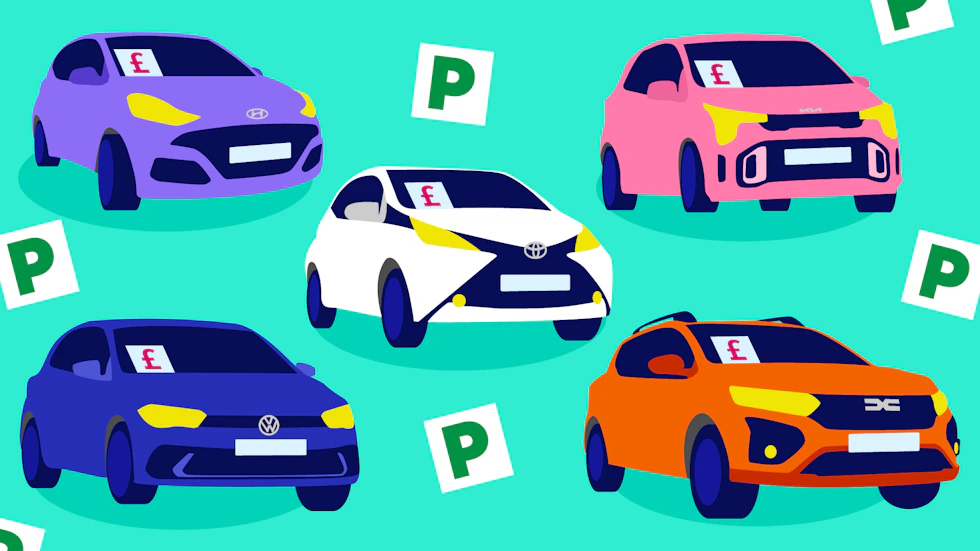
If you’re looking to keep insurance costs down, the key is choosing cars that consistently sit in the lowest insurance groups while still being reliable and practical for everyday driving.
The models below strike that balance – affordable to buy, cheap to run, and crucially, low risk in the eyes of insurers, making them ideal first cars.
Do bear in mind that the figures displayed for each car aren’t exact. You may (or rather will) get different results based upon factors which will be explained later.
1. Hyundai i10 | Est. £600 – £900
- Insurance group: 1-2 for 2020 models onwards
- Best for: Lowest possible premiums
- Extremely low running and repair costs
- Compact, easy to drive, and reliable
The Hyundai i10 is widely considered one of the cheapest cars to insure in the UK – and for good reason.
It’s built with simplicity in mind: small engines, low repair costs, and solid reliability. That combination makes it very low risk for insurers, which translates into cheaper premiums for new drivers.
If your main goal is to pay as little as possible for insurance, this is hard to beat.
2. Kia Picanto | Est. £800 – £1400
- Insurance group: 1-5
- Best for: Value and modern features
- Great warranty (even on used models)
- Modern features without higher insurance costs
The Picanto offers a slightly more modern feel than some city cars, without pushing up insurance costs.
It’s still compact and efficient, but you’ll often get extras like infotainment systems and driver assistance features – especially on newer models. Plus, Kia’s long warranty can carry over to used cars, helping reduce unexpected repair costs.
A great all-rounder if you want low insurance without sacrificing comfort.
3. Toyota Aygo | Est. £641 – £1633
- Insurance group: ~2-7
- Best for: Reliability and low running costs
- Excellent reliability
- Cheap parts and simple mechanics
Toyota has a strong reputation for reliability, and the Aygo is no exception.
It’s cheap to maintain, easy to drive, and designed primarily for city use – which keeps both risk and repair costs low. That’s exactly what insurers like to see.
Ideal if you want a dependable first car that won’t surprise you with costs.
4. Volkswagen Polo (entry-level trims) | Est. £900 – £1300
- Insurance group: ~1-5
- Best for: A more “grown-up” feel
- Solid build quality
- High reliability (German engineering at its finest)
The Polo is slightly larger than typical city cars, making it a popular choice for new drivers who want something that feels a bit more substantial.
Entry-level models still fall into low insurance groups, but you’ll get a more refined interior and better motorway comfort compared to smaller alternatives.
Just make sure to avoid higher spec or sporty trims, which can quickly increase insurance costs.
5. Dacia Sandero | Est. £1000 – £1800
- Insurance group: ~1-5
- Best for: Budget buyers
- One of the cheapest cars to buy new
- Simple and cost-effective to repair
The Sandero is known for being one of the cheapest cars to buy in the UK – and it’s just as appealing when it comes to insurance.
Its simple design keeps repair costs low, and lower overall value means insurers don’t face huge payouts in the event of a claim.
A smart pick if you want to minimise both upfront and ongoing costs.
Honourable mentions
If you’re still shopping around, these cars are also known for low insurance groups:
- Skoda Citigo / VW Up! / SEAT Mii – Some of the lowest insurance groups available
- Ford Fiesta (1.0L or lower) – Widely available and cheap to maintain
- Vauxhall Corsa (smaller engines) – Popular, but trim choice matters
- Peugeot 108 / Citroën C1 – Compact, simple, and city-friendly
As a rule of thumb, always check the exact engine and trim level – even within the same model, insurance costs can vary significantly.
Factors affecting insurance for new drivers

Even if you pick one of the cheapest cars to insure, your premium isn’t based on the car alone.
Insurers look at a range of personal and situational factors to assess how risky you are to cover — and for new drivers, those risks tend to stack up quickly.
Here are the key things that influence what you’ll pay.
Your age and driving experience
This is the biggest factor.
New drivers – especially those under 25 – are statistically more likely to be involved in accidents. With less time on the road, insurers have less evidence that you’re a safe driver.
That’s why premiums are highest in your first few years, then gradually drop as you build experience and a no-claims bonus.
The car itself
Not all cheap cars are equal when it comes to insurance.
Insurers will look at:
- Engine size: Smaller engines are seen as lower risk
- Performance: Faster acceleration = higher likelihood of claims
- Insurance group: A key pricing factor
- Modifications: Even minor changes can increase premiums
Two similar-looking cars can have very different insurance costs depending on spec.
Where you live and park
Your location plays a surprisingly big role.
- Busy urban areas = higher risk of accidents and theft
- High-crime areas = increased likelihood of claims
- Parking type:
- Garage or private driveway = cheaper
- Street parking = more expensive
Insurers price based on postcode risk, not just your driving.
Annual mileage
The more time you spend on the road, the greater the chance of an accident.
- Low mileage (e.g. <5,000 miles/year): Cheaper
- High mileage (e.g. commuting long distances): More expensive
Be realistic – underestimating mileage can invalidate your policy.
Job title
It might sound odd, but your occupation can influence your premium.
Insurers use data to assess how different professions correlate with risk. For example:
- Jobs involving lots of driving may cost more
- Some job titles are statistically linked to fewer claims
Even small wording differences (e.g. “administrator” vs “office assistant”) can sometimes affect quotes.
Level of cover
The type of policy you choose also matters:
- Third-party only: Covers damage to others, often not the cheapest anymore
- Comprehensive: Covers your own car too, and can sometimes be better value
It’s always worth comparing both – the cheapest option isn’t always obvious.
Driving history (or lack of it)
As a new driver, you won’t have:
- A no-claims bonus
- A track record of safe driving
This lack of history makes you a bigger unknown to insurers – which increases your premium.
The key takeaway
Insurance pricing isn’t based on one single factor – it’s a combination of you, your car, and your circumstances. That’s why two new drivers with the same car can get completely different quotes.
What is a no-claims bonus?
A no-claims bonus (NCB) is a discount you earn on your car insurance for every year you don’t make a claim.
The longer you go without claiming, the bigger the discount – which can significantly reduce your premium over time.
For example, after a few claim-free years, you could pay much less than a brand-new driver with no bonus.
Tips to lower insurance premiums
Car insurance might feel expensive at first, but it’s not fixed. There are plenty of ways to bring the price down with the right approach.
A big part of it comes down to how insurers assess risk. The more you can show that you’re a careful, low-risk driver, the more likely you are to get a better deal.
One of the easiest ways to do this is through how your policy is set up. Adding a more experienced named driver can help balance out your risk, while choosing a higher voluntary excess can reduce your monthly cost – as long as it’s still affordable if you need to claim.
Your driving behaviour and habits also play a role. Telematics (or “black box”) insurance is designed specifically for new drivers, rewarding safe driving with lower premiums over time. Even something as simple as driving fewer miles each year can make a difference.
Then there’s the car itself. Keeping your vehicle completely standard, choosing a smaller engine, and avoiding sportier trims all help keep insurance costs down. Where you keep your car matters too — parking on a driveway or in a garage is seen as lower risk than leaving it on the street.
Finally, it’s worth thinking long term. Building a no-claims bonus by avoiding claims is one of the most effective ways to reduce your insurance costs over time, with bigger discounts each year you go claim-free.
The bottom line
There’s no single trick to cheap insurance – it’s about stacking small advantages. Choose the right car, show you’re a low-risk driver, and take advantage of every available discount.
Finding the best car insurance

Once you’ve picked the right car, the final step is making sure you’re not paying more than you need to.
Insurance prices can vary significantly between providers – even for the same driver – so taking a bit of extra time here can save you a surprising amount.
- Compare quotes from multiple providers
Prices aren’t standardised, so one insurer might see you as higher risk than another. Using comparison tools helps you quickly spot the most competitive deals instead of settling for the first quote you see. - Check both comprehensive and third-party options
It might seem logical that third-party cover is cheaper, but that’s not always the case. Comprehensive policies can sometimes offer better value, so it’s worth comparing both before deciding. - Don’t just pick the cheapest – look at excess, cover, and add-ons
A low premium doesn’t always mean good value. Check how much you’d need to pay if you claim (excess), what’s actually covered, and whether extras like breakdown cover or a courtesy car are included.
Genius Tip: SwitchGenius makes it easy to see the best deals in one place – and find policies tailored to new drivers! Head over to our car insurance comparison page and start finding the right deal for you!