Access to fast, reliable broadband isn’t always a given in rural areas.
While fibre broadband continues to expand across the UK, many homes and businesses in more remote locations are still waiting for access. That doesn’t mean you’re stuck with slow speeds, though.
There are several alternative broadband options available that can deliver solid performance without relying on fibre infrastructure.
In this guide, we’ll explore the best broadband solutions for rural areas and help you decide which one is right for you.
Why fibre broadband isn’t always available in rural areas

Fibre broadband rollout has made significant progress in recent years, but rural areas often lag behind. The main reason comes down to infrastructure challenges.
Installing fibre cables over long distances to reach small, spread-out communities is expensive and time-consuming. Providers tend to prioritise urban and suburban areas where more customers can be connected quickly, making the investment more worthwhile.
Geography can also play a role. Hills, forests, and remote terrain can make installation more complex, further slowing down rollout in rural regions.
While government initiatives and provider investments are helping to close the gap, many rural households still need to rely on alternative broadband solutions for the foreseeable future.
Best options for broadband in rural areas
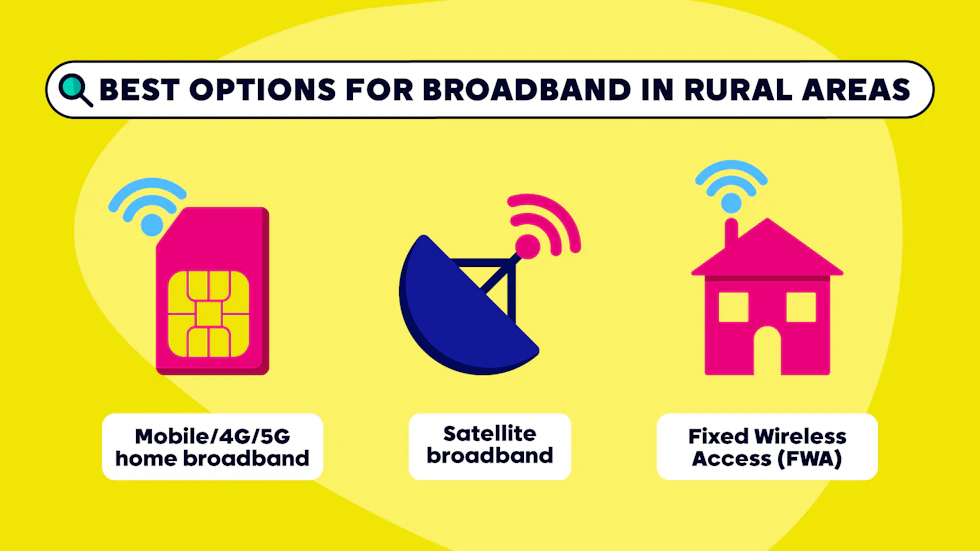
If fibre isn’t available where you live, there are still several reliable ways to get online. Here are the main options to consider:
Mobile 4G and 5G home broadband
Mobile 4G and 5G home broadband use mobile networks to deliver internet access, making them one of the most accessible solutions for rural areas.
In many parts of the UK, 4G coverage is widespread and can provide speeds that are more than enough for everyday use, including streaming, video calls, and working from home.
If 5G is available in your area, it can offer significantly faster speeds and lower latency, bringing performance closer to fibre in some cases. Another major advantage is ease of setup – most providers offer plug-and-play routers with no need for engineer visits.
However, speeds can vary depending on signal strength, network congestion, and your distance from the nearest mast. That’s why it’s essential to check coverage maps and, if possible, test different networks before committing.
| Pros | Cons |
| Widely available across the UK | Speeds depend on signal strength |
| Quick and easy setup | Can be affected by network congestion |
| No need for a landline | Data limits on some plans |
Satellite broadband
Satellite broadband is often the go-to option for the most remote rural locations, as it doesn’t rely on ground-based infrastructure. Instead, it connects your home directly to satellites, meaning it can provide coverage virtually anywhere.
This makes it especially useful for properties where both fibre and mobile coverage are limited or unavailable. Modern satellite services have improved significantly, offering faster speeds and more reliable connections than older systems.
That said, satellite broadband still comes with some trade-offs. Latency is typically higher due to the distance signals must travel, which can impact activities like online gaming or real-time video calls.
Installation can also require specialist equipment, and monthly costs tend to be higher than other options.
| Pros | Cons |
| Available almost everywhere | Higher latency (delay) |
| Reliable in remote locations | Higher costs and setup fees |
| Independent of local infrastructure | Weather can affect performance |
Fixed Wireless Access (FWA) broadband
Fixed Wireless Access broadband, or FWA broadband, delivers internet to your home using radio signals from a nearby base station or mast. While this might sound similar to 4G or 5G home broadband, there’s an important difference: fixed wireless uses dedicated equipment installed at your property, usually a small antenna or receiver mounted on your roof or an external wall.
This creates a direct, point-to-point connection between your home and the provider’s mast. Because of this, fixed wireless connections are typically more stable and consistent than mobile broadband, which shares network capacity with other users in the area (like smartphone traffic).
In many rural locations, fixed wireless can offer faster and more reliable speeds than 4G, especially during peak times when mobile networks may become congested. However, it does require a clear line of sight between your property and the mast, meaning trees, hills, or buildings can affect availability.
Unlike plug-and-play mobile broadband, installation usually requires an engineer visit to set up the external receiver. Availability is also more limited, as services are often provided by smaller, regional networks rather than national providers.
| Pros | Cons |
| More stable than mobile broadband | Limited availability |
| Dedicated connection (less congestion) | Requires line-of-sight to mast |
| Can offer faster rural speeds | Professional installation needed |
How to choose the right rural broadband option
Choosing the best broadband for your rural home depends on a few key factors.
Start by checking what’s actually available in your area. Mobile coverage varies between networks, so it’s worth comparing providers to find the strongest signal. For satellite or FWA, you’ll need to check provider-specific coverage maps.
Next, think about how you use the internet. If you mainly browse and stream occasionally, 4G broadband may be more than enough.
For heavier usage such as working from home, video calls, or streaming in multiple rooms, you may want to prioritise faster or more stable options.
Budget is another important consideration. Mobile broadband is often more affordable while satellite services can come with higher upfront costs due to installation fees. FWA pricing varies depending on the provider and package.
Finally, consider installation and equipment. Some options, like mobile broadband, are plug-and-play, while FWA requires professional installation and external antennas. Some satellite broadband providers offer the option of an engineer installation or self installation, with the latter saving you some money at the cost of knowing what you’re doing.
Tips to improve your rural broadband speed

Even with the best available option, any broadband performance can be affected by various factors, especially so for more remote premises. Fortunately, there are a few simple ways to improve your connection.
Positioning your router correctly can make a noticeable difference. Placing it near a window or higher up in your home can help improve signal reception, especially for mobile broadband. If your connection is still underperforming, it’s worth understanding to identify potential issues.
External antennas or signal boosters can also enhance performance by strengthening weak signals. These can be particularly useful in areas with patchy coverage.
It’s also worth comparing different providers. Coverage can vary significantly between networks, so switching to a provider with a stronger signal in your area could lead to better speeds.
In some cases, combining solutions may be an option. For example, you could use 4G broadband as your main connection and keep satellite as a backup for added reliability.