BT Group is one of the biggest names in UK telecommunications, but it’s more than just the BT broadband and mobile services many people recognise.
Over the years, the company has expanded to include several well-known consumer brands, each serving a slightly different purpose.
Find out which providers are part of BT Group, what each brand offers, and whether being under the same parent company makes a difference when choosing your next broadband or mobile deal.
What is BT Group?
BT Group is a British telecommunications company that provides the infrastructure and services powering much of the UK’s internet, phone and mobile connectivity.
While many people associate the company with BT Broadband, BT Group is actually the parent organisation behind several household-name brands.
Originally founded as British Telecom following the privatisation of the UK’s telephone network in the 1980s, the company has evolved into one of the country’s largest communications providers.
Today, BT Group serves millions of residential and business customers, offering everything from full fibre broadband and mobile networks to cloud services, cybersecurity and business communications.
Although its consumer-facing brands each have their own products, pricing and identities, they all benefit from BT Group’s investment in network infrastructure and technology. That allows the company to offer services across a wide range of budgets and customer needs, from premium broadband and entertainment packages to more affordable, no-frills connectivity.
It’s also worth noting that BT Group is different from the BT brand itself. BT is simply one of the consumer brands owned by the wider BT Group while Openreach, one of the brands associated, operates as the group’s network infrastructure business, building and maintaining much of the UK’s broadband and telephone network.
Which providers are owned by BT Group?
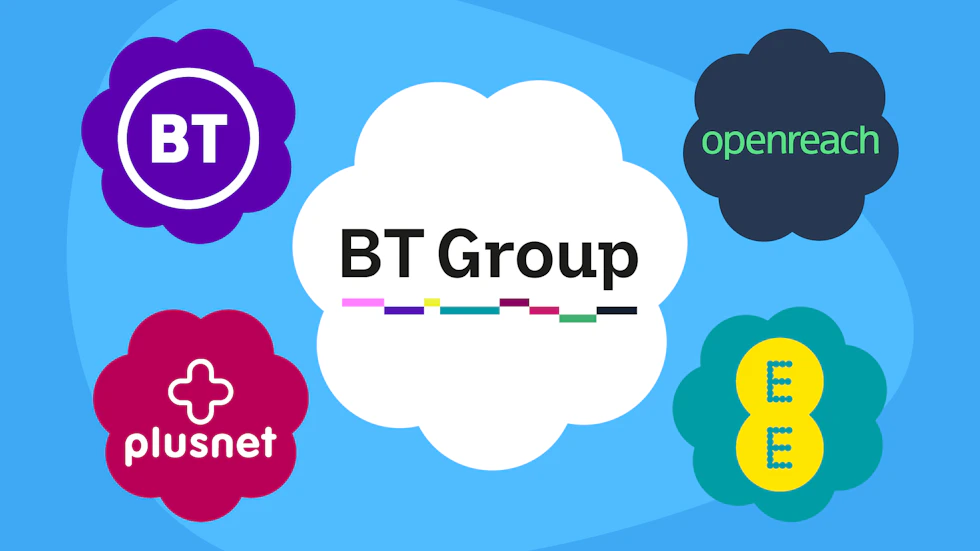
BT Group owns several well-known consumer and infrastructure brands, each playing a different role in delivering broadband, mobile and communication services across the UK.
- BT – The group’s flagship consumer brand, offering broadband, TV, home phone and mobile services.
- EE – The UK’s largest mobile network, now also providing full fibre broadband and TV packages.
- Plusnet – A value-focused broadband provider known for straightforward packages and competitive pricing.
- Openreach – The network infrastructure company responsible for building and maintaining much of the UK’s broadband and telephone network, used by BT and many other providers.
Although these brands are all part of BT Group, they continue to operate independently, with their own products, pricing, customer support and branding. That means choosing between them still comes down to your budget, priorities and the services you’re looking for.
BT
As the flagship consumer brand within BT Group, BT offers a wide range of home broadband, TV, mobile and phone services to millions of customers across the UK.
While it shares ownership with EE, Plusnet and Openreach, the BT brand remains focused on delivering premium connectivity, entertainment and digital services for both households and businesses.
Unlike some of the group’s other brands, BT has been at the heart of the company since its formation. Originally known as British Telecom, the business was privatised in 1984 before rebranding to BT in the early 1990s. Today, it continues to represent the group’s primary consumer broadband and communications brand.
BT broadband, TV and mobile
BT’s consumer offering centres around its Full Fibre and Fibre Essential broadband packages, with speeds available up to 1.8Gbps in selected areas.
Customers can also bundle broadband with EE TV, featuring flexible entertainment packages, as well as mobile plans powered by the EE network following the companies’ integration.
The provider has increasingly focused on converged services, allowing customers to combine broadband, mobile and TV under one account. Features such as Digital Voice have also replaced traditional landline services for many new customers, reflecting the UK’s move towards all-IP communications.
BT Business
Alongside its consumer products, BT Business provides connectivity and communication services for organisations of all sizes, from sole traders to large enterprises. Its portfolio includes business broadband, leased lines, cloud communications, cybersecurity, mobile services and networking solutions designed to support modern workplaces.
BT Business also plays a significant role in public sector and enterprise communications, supplying services to government departments, healthcare providers and major UK businesses. This makes it one of the country’s largest providers of commercial telecommunications services, extending far beyond the residential broadband market.
EE
EE became part of BT Group in 2016 following BT’s £12.5 billion acquisition of the mobile network. The move brought together the UK’s largest fixed broadband provider and its largest mobile network, allowing BT Group to offer a more integrated range of broadband, mobile and entertainment services through two of the country’s biggest telecommunications brands.
Today, EE has grown beyond its mobile roots to become a major broadband and TV provider in its own right. While it continues to operate as a separate brand within BT Group, it plays a central role in the company’s strategy of delivering connected services across home and mobile networks.
EE mobile, broadband and TV
EE is best known as the UK’s largest mobile network, offering extensive 4G and 5G coverage alongside a wide selection of SIM-only deals, Pay Monthly contracts and connected devices.
Since joining BT Group, the brand has also expanded its home broadband portfolio, with Full Fibre packages available across much of the UK using the Openreach network.
Customers can also choose TV packages through EE TV, bringing together live television and popular streaming services in one place.
Combined with broadband and mobile plans, EE offers a range of bundled services designed to keep customers connected both at home and on the move.
EE’s role within BT Group
Since becoming part of BT Group, EE has become the company’s primary mobile brand while continuing to grow its presence in the home broadband market. BT Group has invested heavily in EE’s network infrastructure, helping to expand 5G coverage, improve mobile performance and strengthen its nationwide broadband offering.
The close relationship between BT and EE also allows customers to access a range of combined services and exclusive benefits, although the two brands continue to offer their own products, pricing and customer support.
One of the biggest examples of the brands working together is BT’s home entertainment offering. While BT TV is no longer available to new customers, those taking out BT broadband can now add EE TV as their television service.
This means customers still enjoy bundled broadband and TV packages through BT, with EE providing the TV platform and streaming experience.
Together, they form the cornerstone of BT Group’s consumer telecommunications business.
Plusnet
Plusnet has been part of BT Group since 2007, when BT acquired the Sheffield-based broadband provider.
Despite being owned by BT Group, Plusnet has continued to operate as its own standalone consumer brand, maintaining a distinct identity with a focus on straightforward broadband packages, competitive pricing and award-winning customer service.
Rather than competing directly with BT or EE’s premium offerings, Plusnet has carved out a reputation as a provider that prioritises simplicity and value. It offers a streamlined range of broadband products without the extensive TV bundles or premium extras found elsewhere within the group.
Plusnet broadband
Plusnet provides Fibre and Full Fibre broadband packages for homes across the UK, with all services delivered using the Openreach network. This gives customers access to the same underlying infrastructure used by BT and many other providers, while still receiving Plusnet’s own pricing, customer support and account management.
By keeping its product range simple, Plusnet aims to make choosing broadband as straightforward as possible.
Customers benefit from unlimited data, reliable UK-based support and a no-frills approach that appeals to households looking for dependable connectivity without unnecessary add-ons.
Plusnet’s place within BT Group
Although Plusnet shares ownership with BT and EE, it operates independently with its own website, customer service teams and broadband packages.
Its role within BT Group is to provide a value-focused alternative, giving customers another option without leaving the wider BT family.
One of Plusnet’s biggest strengths is its reputation for customer service. The provider has received numerous industry awards and consistently performs well in customer satisfaction surveys, earning recognition for its helpful support, ease of service and overall value.
Combined with the reliability of the Openreach network, this has helped Plusnet build a loyal customer base while retaining its own identity within BT Group.
Openreach
Openreach became a distinct business within BT Group in 2006 and today operates as the UK’s largest broadband network provider.
Unlike BT, EE and Plusnet, Openreach doesn’t sell broadband directly to consumers. Instead, it builds, maintains and upgrades the infrastructure that allows more than 650 communications providers to deliver broadband and phone services to homes and businesses across the country.
Although it remains part of BT Group, Openreach operates independently to ensure all providers receive equal access to its network.
Over the past two decades, Openreach has played a pivotal role in transforming the UK’s digital connectivity. From replacing ageing copper infrastructure with fibre technology to connecting rural communities and major cities alike, its investment has helped millions of households access faster and more reliable broadband than ever before.
Building the UK’s broadband network
Openreach is responsible for maintaining much of the physical infrastructure that keeps the UK connected, including telephone exchanges, street cabinets, underground ducts, telegraph poles and millions of miles of cabling. Whenever a customer orders broadband from a provider that uses the Openreach network, it’s often an Openreach engineer who carries out the installation or repairs.
Its network supports the vast majority of broadband providers in the UK, including BT, EE, Plusnet, Sky, TalkTalk, Vodafone and many others. This shared approach allows dozens of providers to compete on price, speed and customer service while relying on the same underlying infrastructure.
Driving the UK’s full fibre future
In recent years, Openreach has led one of the biggest infrastructure projects in the UK’s history through its nationwide full fibre rollout.
The company plans to make Full Fibre broadband available to 25 million homes and businesses by the end of 2026, with ambitions to extend coverage to 30 million premises by the end of the decade, helping to support the UK’s wider gigabit broadband goals.
Looking ahead, Openreach says its focus is on building “the best possible network” for the UK while expanding reliable, future-ready connectivity to even more communities.
As demand for streaming, cloud services, remote working and connected devices continues to grow, its ongoing investment will help ensure the country’s digital infrastructure is ready for the next generation of technology.
Does being part of BT Group affect customers?
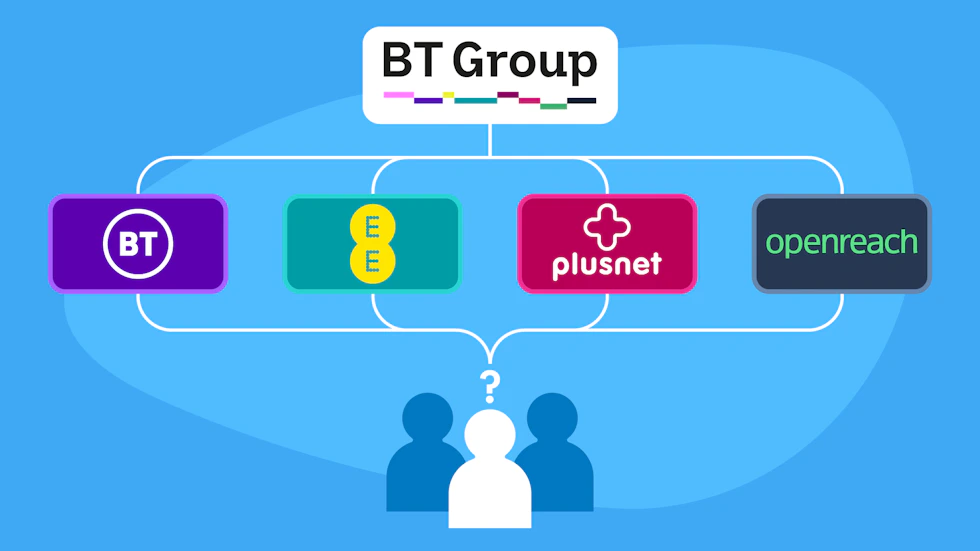
For the most part, being part of BT Group has very little impact on the day-to-day experience of customers. BT, EE and Plusnet all continue to operate as separate brands with their own websites, customer service teams, products and pricing. However, behind the scenes, being owned by the same parent company does bring several advantages.
Shared network infrastructure
One of the biggest benefits comes from the group’s shared investment in network infrastructure. Through Openreach, BT Group has invested billions of pounds into expanding Full Fibre broadband across the UK, allowing BT, EE, Plusnet and hundreds of other providers to offer faster, more reliable broadband to millions of homes.
Because Openreach operates independently, customers of competing providers such as Sky, TalkTalk and Vodafone can also benefit from the same fibre rollout. This means BT Group’s investment doesn’t just support its own brands, but helps improve broadband connectivity across the UK as a whole.
A stronger mobile network
BT’s acquisition of EE in 2016 also transformed the group’s mobile offering. Since joining BT Group, EE has benefited from significant investment in its network, helping to expand 4G and 5G coverage, increase download speeds and improve overall reliability.
Today, EE is widely regarded as one of the UK’s leading mobile networks, regularly performing strongly in independent tests for speed, coverage and network performance. BT Group’s continued investment has helped cement EE’s position as a premium mobile provider while allowing the wider group to offer seamless broadband and mobile services under one umbrella.
Better connected services
Although each brand has its own identity, BT Group’s structure makes it easier to offer connected products across broadband, TV and mobile. A good example is the relationship between BT Broadband and EE TV, where customers can now bundle BT broadband with EE’s television platform following the retirement of BT TV.
The close links between the brands have also enabled shared technologies, improved customer features and more integrated services, while still allowing BT, EE and Plusnet to cater for different types of customers. For consumers, this means there’s a choice of providers within the same group, each offering a slightly different approach to broadband and mobile connectivity.
Should you choose a BT Group provider?
Whether a BT Group provider is the right choice ultimately depends on what you’re looking for.
While the brands all sit under the same parent company, they each serve a different purpose, giving customers a choice between premium services, value-focused broadband or market-leading mobile connectivity.
BT is geared towards households wanting fast broadband, TV and mobile services in one place, while EE combines one of the UK’s strongest mobile networks with an expanding full fibre broadband offering.
Plusnet takes a simpler approach, focusing on affordable broadband backed by highly rated customer service, and Openreach, while not a direct provider, works behind the scenes to deliver the infrastructure that supports not only BT Group’s brands, but hundreds of providers across the UK.
Perhaps the biggest advantage of BT Group is its continued investment in the UK’s digital infrastructure.
From expanding full fibre broadband through Openreach to strengthening EE’s award-winning mobile network, the group has played a major role in improving connectivity for millions of homes and businesses.
Ultimately, it’s worth comparing each provider on its own merits rather than choosing based on ownership alone.
Factors such as broadband speeds, contract length, monthly costs, customer service and any additional features will have a much bigger impact on your experience.
By comparing the latest broadband and mobile deals, you can find the provider that best suits your needs, whether that’s within BT Group or elsewhere.